

Replace
What It Does
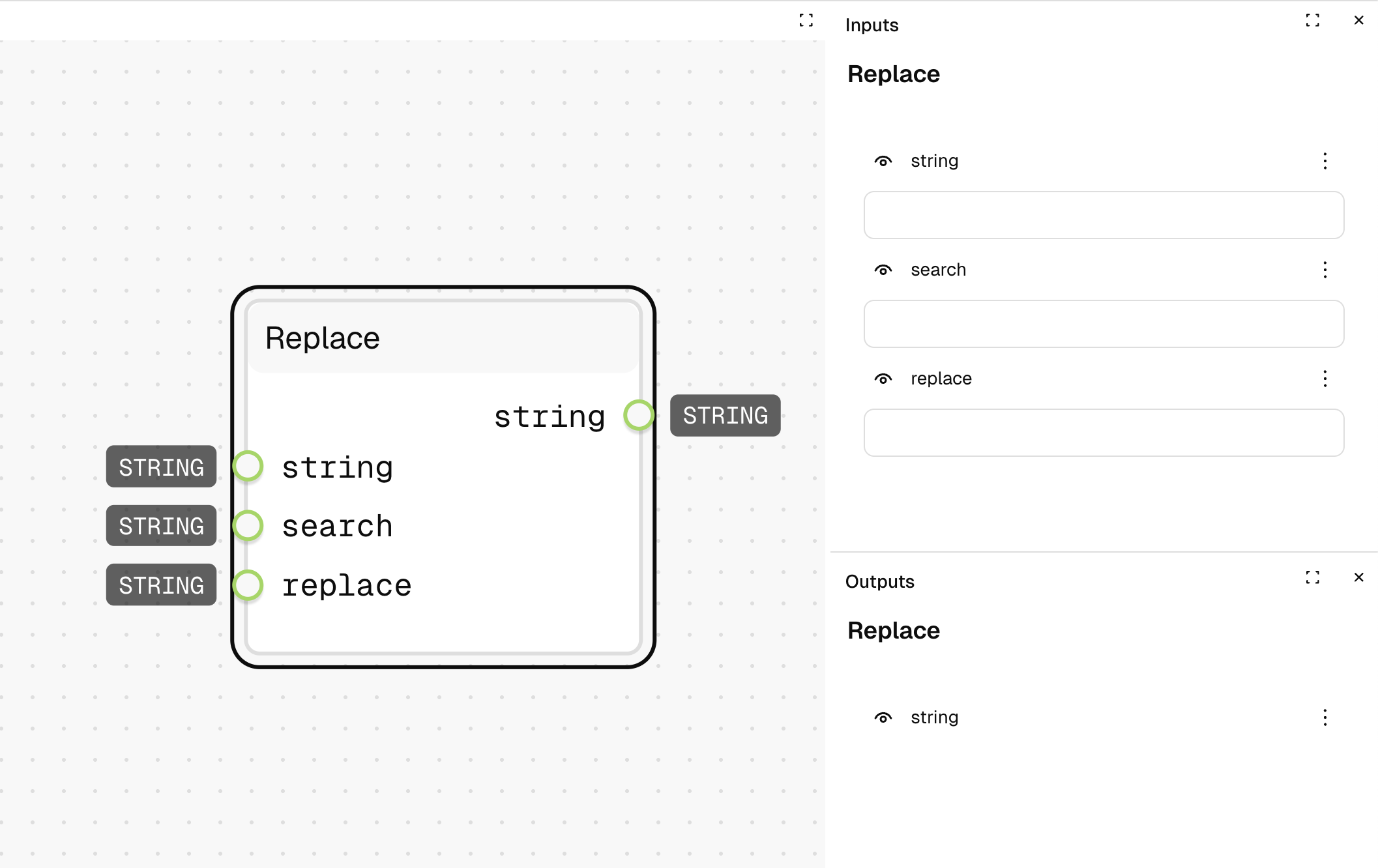
Finds and replaces all occurrences of a search string with a replacement string. This is useful for removing, substituting, or modifying specific parts of text.
Inputs
| Name | Description | Type | Required |
|---|---|---|---|
| string | The original text to perform replacements on | String | Yes |
| search | The text pattern to find and replace | String | Yes |
| replace | The new text to insert in place of the search text | String | No |
Outputs
| Name | Description | Type |
|---|---|---|
| string | The resulting text after all replacements | String |
How to Use It
- Drag the Replace node into your graph.
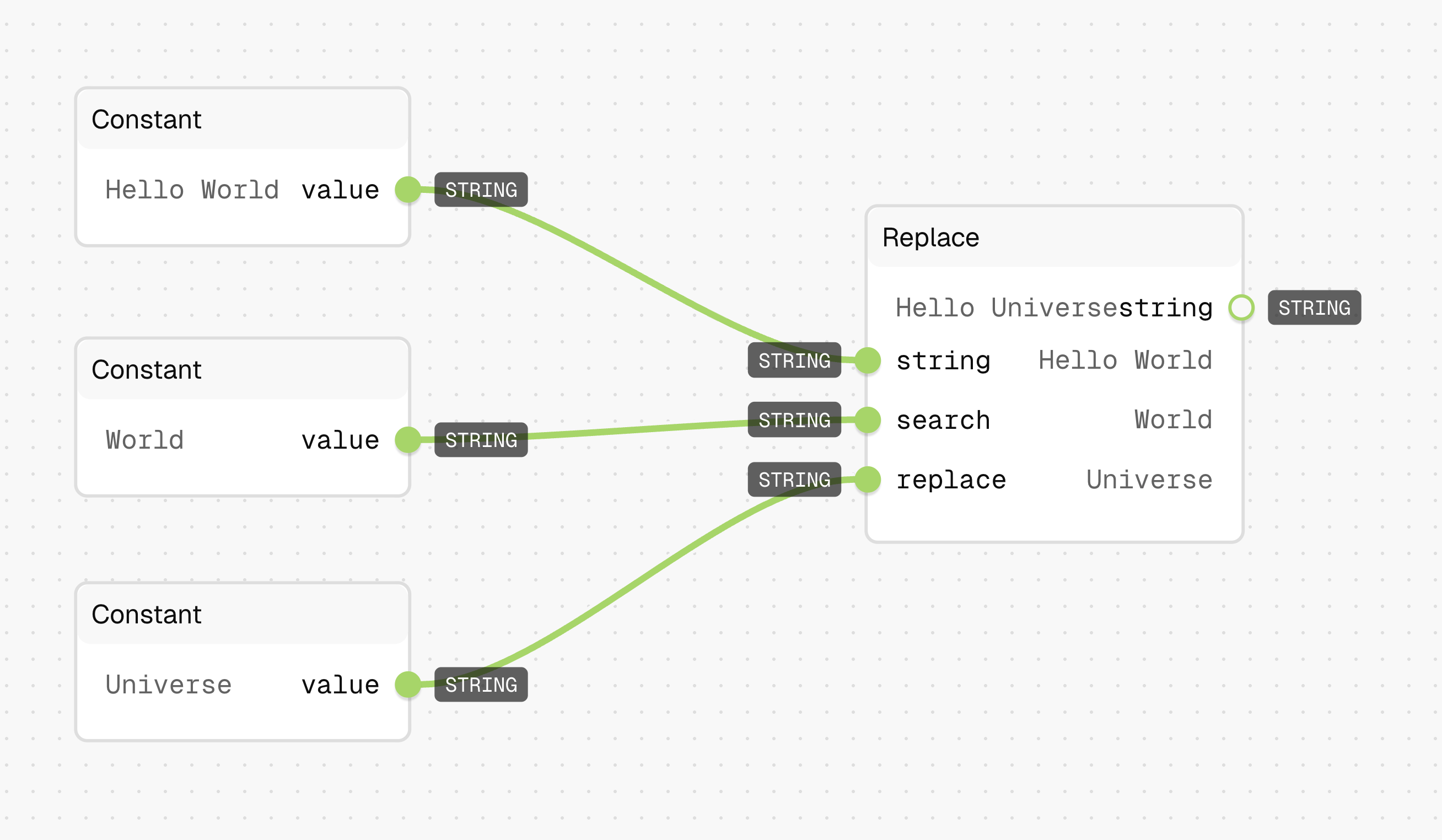
- Connect your source text to the "string" input (like
"Hello World"). - Set the "search" input to the text you want to replace (like
"World"). - Set the "replace" input to the replacement text (like
"Universe"). - The output will be
"Hello Universe".
Tips
- To remove text entirely, leave the "replace" input empty or set it to an empty string.
- This node replaces all occurrences, not just the first match.
- This node is case sensitive.
See Also
- Split: For breaking text into parts based on a separator.
- Regex: For more advanced pattern matching and replacement.
Use Cases
- Text Cleaning: Remove unwanted characters or fix common typos in text.
- Token Formatting: Convert token references like
{spacing.sm}to their actual values. - Content Variations: Create different text versions by replacing key terms or phrases.