

Exponentiation
What It Does
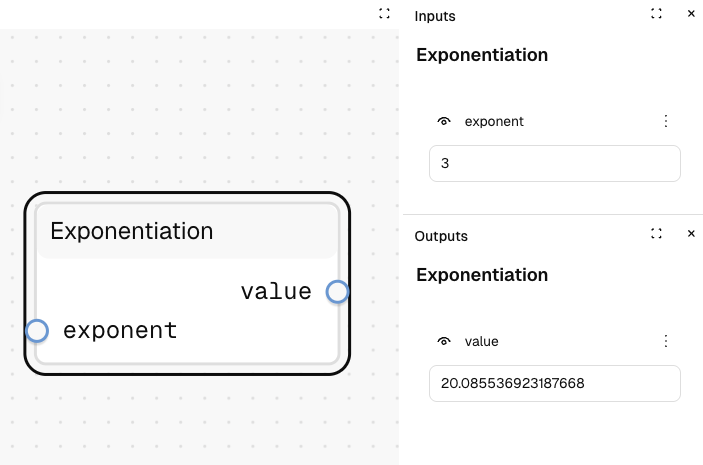
The Exponentiation node calculates e (Euler's number, approximately 2.71828) raised to a specified power. This function creates exponential growth or decay and is particularly useful for natural growth patterns.
Inputs
| Name | Description | Type | Required |
|---|---|---|---|
| Exponent | The power to raise e to | Number | Yes |
Outputs
| Name | Description | Type |
|---|---|---|
| Value | The result of e^exponent | Number |
How to Use It
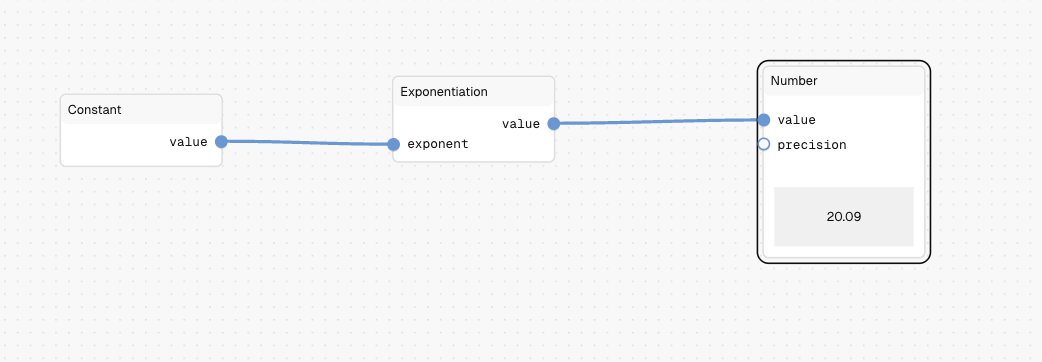
- Drag the Exponentiation node into your graph.
- Connect a number to the "Exponent" input.
- The output will be e raised to the power of the input value.
- Use this for creating natural exponential growth or decay patterns.
Tips
- Positive exponents create exponential growth (faster than linear or polynomial).
- Negative exponents create exponential decay, approaching zero.
- An exponent of 0 always outputs 1.
See Also
Use Cases
- Natural Growth Patterns: Model organic growth in design elements like spacing.
- Decay Effects: Create natural fading or transition effects.
- Smooth Non-linear Scaling: Generate values that change at an exponential rate.