

Numeric Scale
What It Does
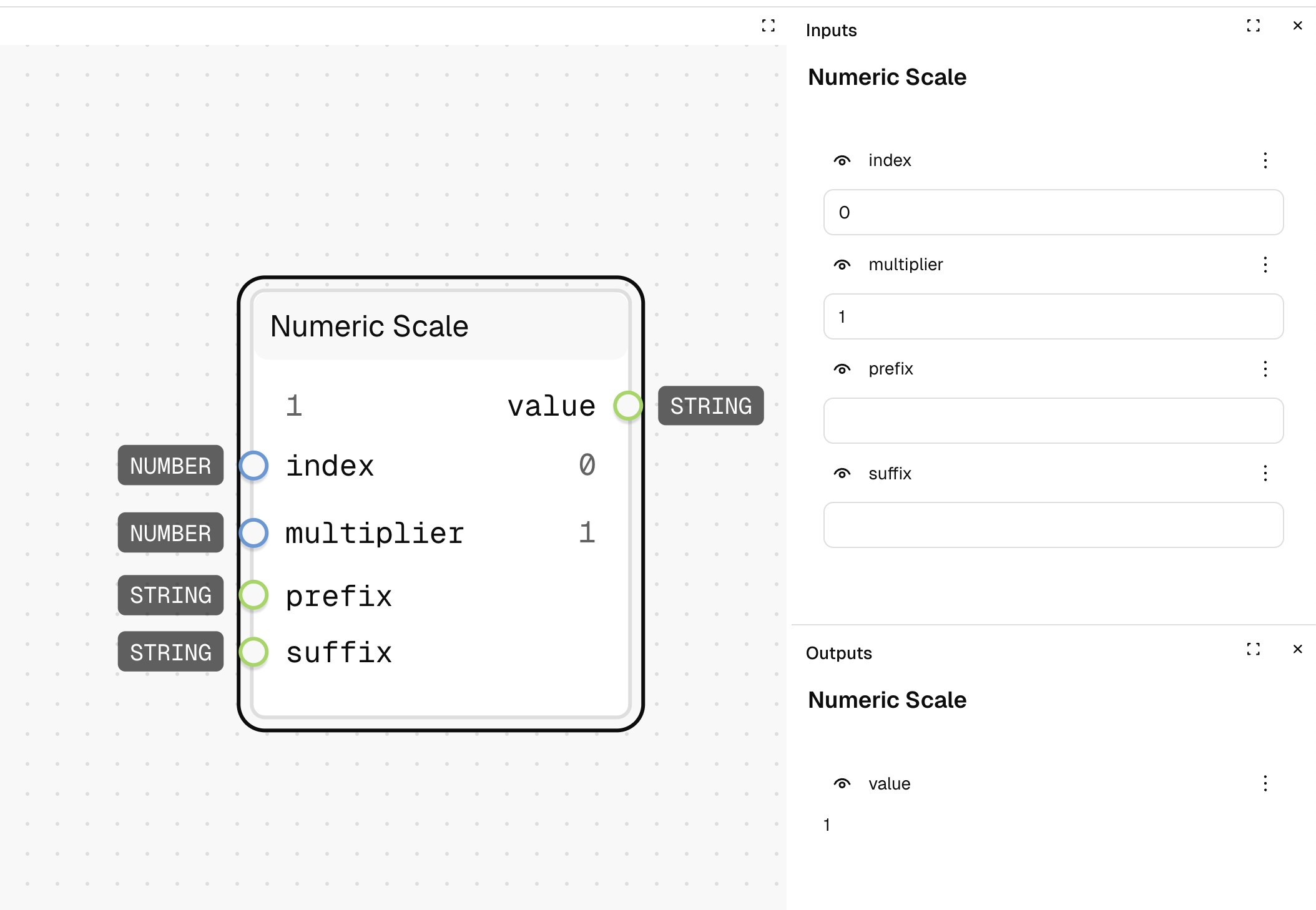
The Numeric Scale node generates numeric values based on an index, with options to apply a multiplier and add prefix/suffix text. It's designed to create numerical sequences for systematic naming in design token collections.
Inputs
| Name | Description | Type | Required |
|---|---|---|---|
| Index | Base index number for the scale (starting at 0) | Number | Yes |
| Multiplier | Value to multiply the index by (e.g., 100 for scale of 100, 200, 300) | Number | No |
| Prefix | Optional text to add before the number | String | No |
| Suffix | Optional text to add after the number | String | No |
Outputs
| Name | Description | Type |
|---|---|---|
| Value | The generated numeric value with optional prefix and suffix | String |
How to Use It
- Drag the Numeric Scale node into your graph.
- Connect a number to the "Index" input or set it directly (for e.g., 0 corresponding to 1).
- Configure the optional inputs:
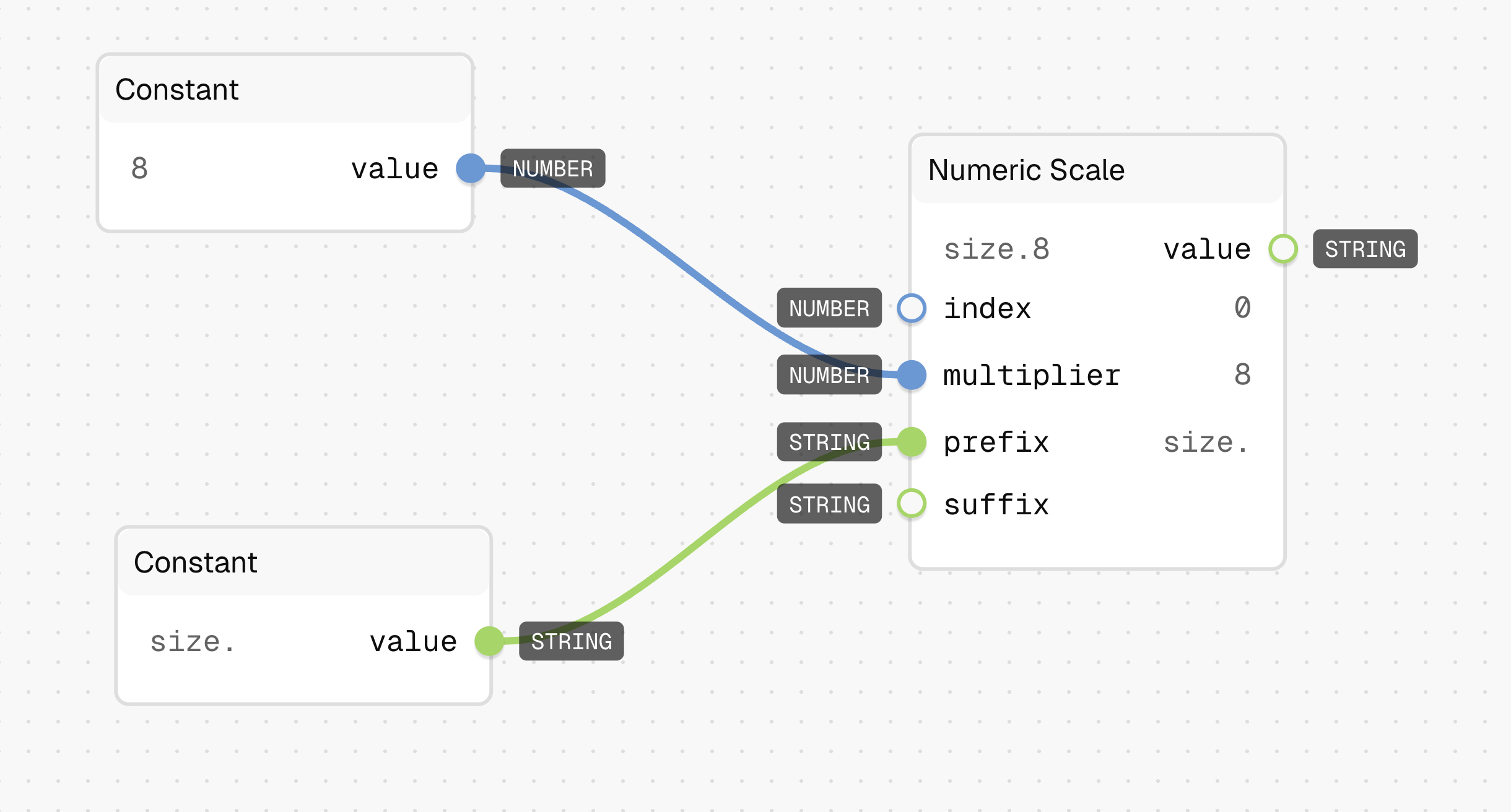
- Set "Multiplier" to control the spacing between numbers (default is 1), for e.g., 8.
- Add a "Prefix" and/or "Suffix" if needed.
- The node will output a string with the calculated numeric value.
Tips
- The node automatically adds 1 to the index before applying the multiplier, so index 0 produces the first number in the sequence.
- Use a multiplier of 100 to create standard design token scales (100, 200, 300).
- Connect this node to a Count node to generate a sequence of increasing numbers.
See Also
- Alphabetic Scale: For generating alphabetic sequences.
- T-shirt Size: For generating t-shirt size scales (XS, S, M, L, XL).
Use Cases
- Weight Scales: Create systematic names for font weights or color intensity (100, 200, 300, etc.).
- Spacing Systems: Generate consistent spacing values at regular intervals.
- Opacity Scales: Create opacity values that follow a predictable pattern.
- Elevation Systems: Build systematic z-index or shadow elevation values.