

Object Path
What It Does
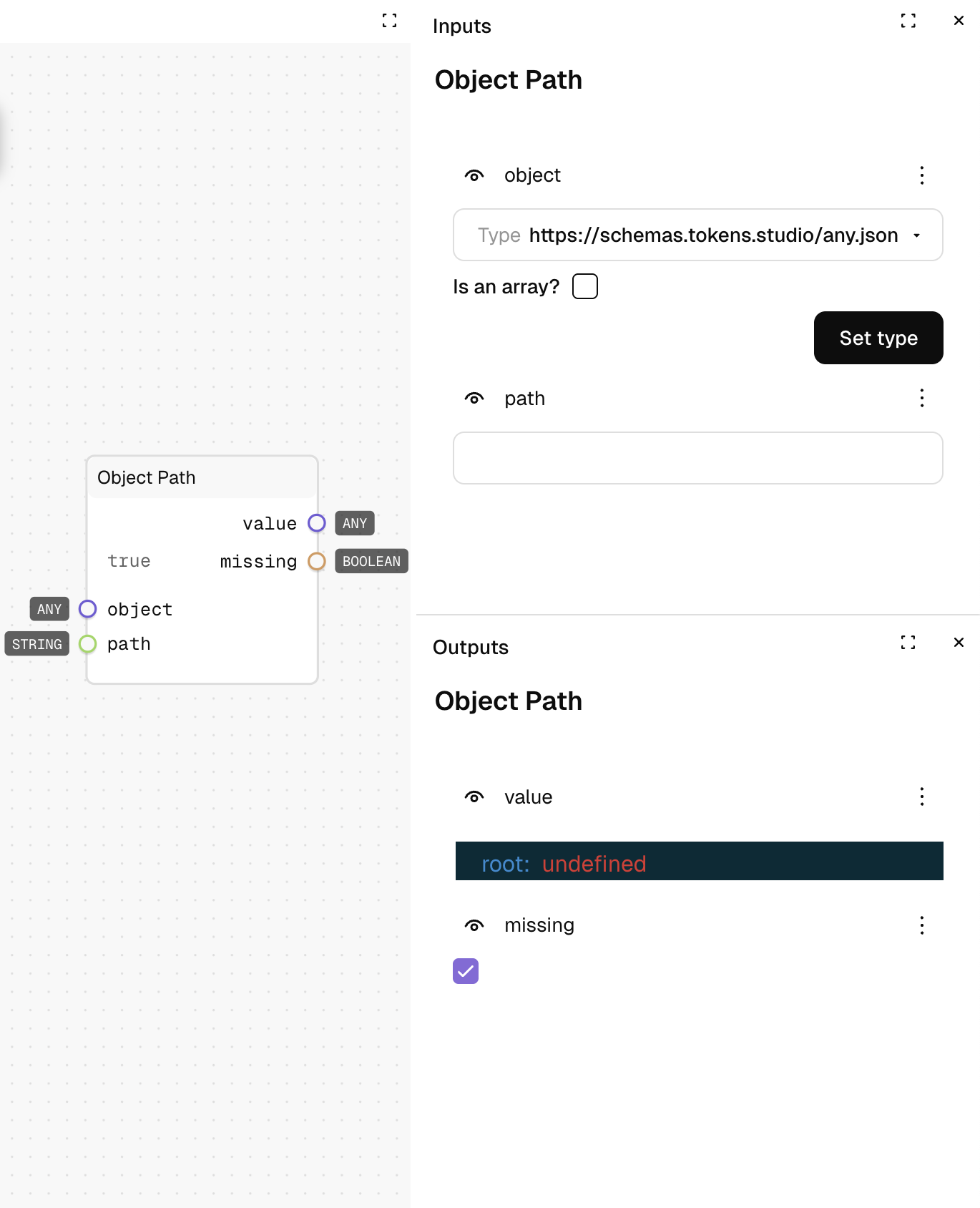
The Object Path node extracts a specific value from within a nested object structure using a dot notation path. It helps you access deeply nested properties without having to create multiple nodes.
Inputs
| Name | Description | Type | Required |
|---|---|---|---|
| Object | The object you want to extract data from | Any | Yes |
| Path | The location of the property you want (using dot notation like "colors.primary") | Text | Yes |
Outputs
| Name | Description | Type |
|---|---|---|
| Value | The extracted property value at the specified path | Any |
| Missing | Indicates whether the property was found (true if missing) | Yes/No |
How to Use It
- Drag the Object Path node into your graph.
- Connect an object to the "Object" input.
- Set the "Path" input to specify which property to extract (e.g., "theme.colors.primary").
- Run the graph to receive the value at that path and a missing flag.
Tips
- Use dot notation to navigate nested structures (e.g., "colors.primary.500").
- Check the "Missing" output to determine if the property exists in the object.
See Also
- Merge objects: For combining multiple objects together.
- Objectify: For creating objects from key-value pairs.
Use Cases
- Token Extraction: Pull specific values from a complex token structure (like typography.body.fontSize).
- Conditional Logic: Check if specific properties exist before using them.
- Data Transformation: Extract and reformat specific parts of complex data structures.