

Mix Colors
What It Does
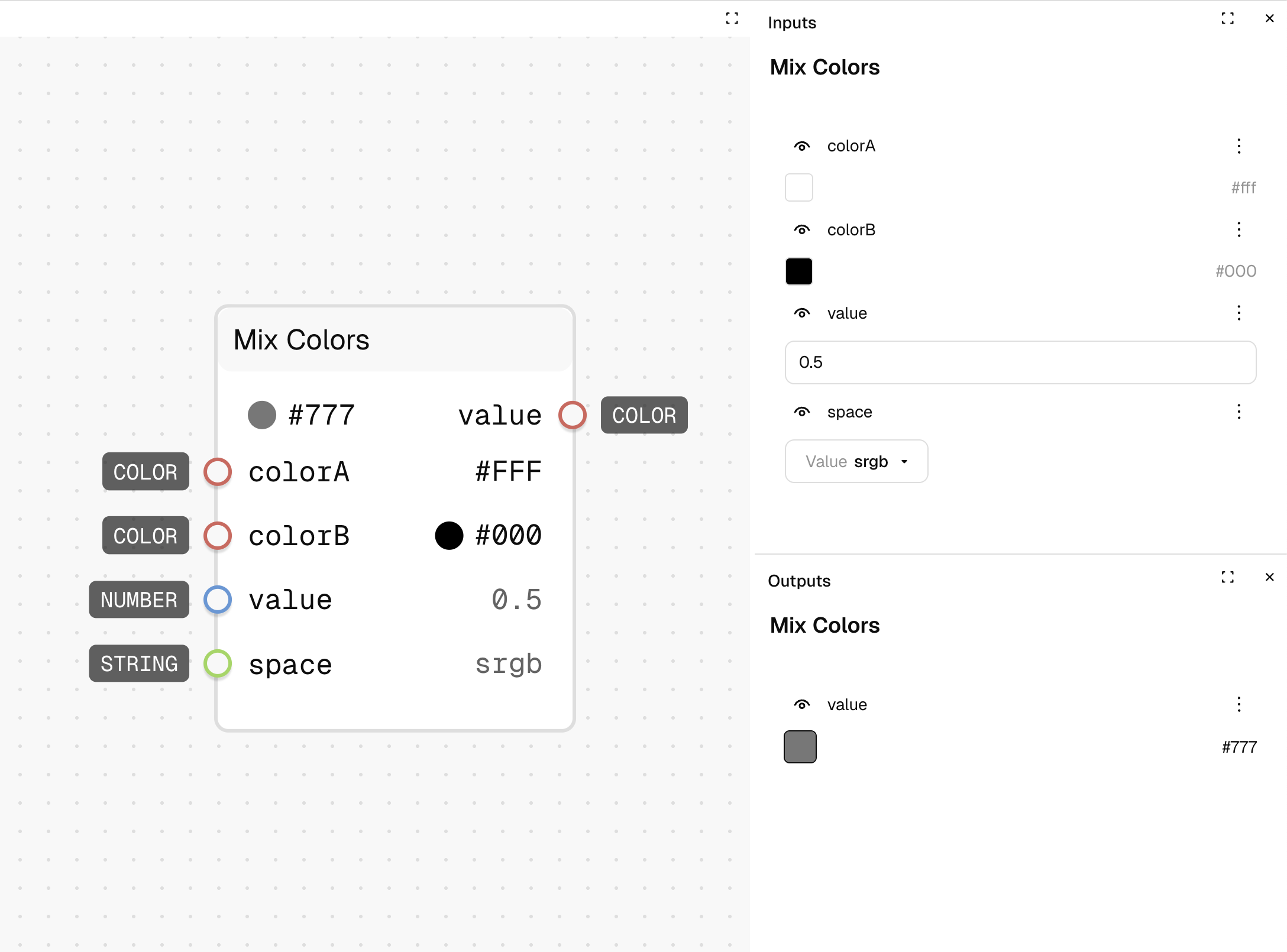
Blends two colors together at a specified ratio. This creates smooth transitions between colors and is perfect for generating intermediate shades or creating color relationships.
Inputs
| Name | Description | Type | Required |
|---|---|---|---|
| colorA | The first color to mix | Color | No |
| colorB | The second color to mix | Color | No |
| value | The mixing ratio (0-1), where 0 is fully colorA and 1 is fully colorB | Number | No |
| space | The color space to perform the mixing in | String | No |
Outputs
| Name | Description | Type |
|---|---|---|
| value | The resulting mixed color | Color |
How to Use It
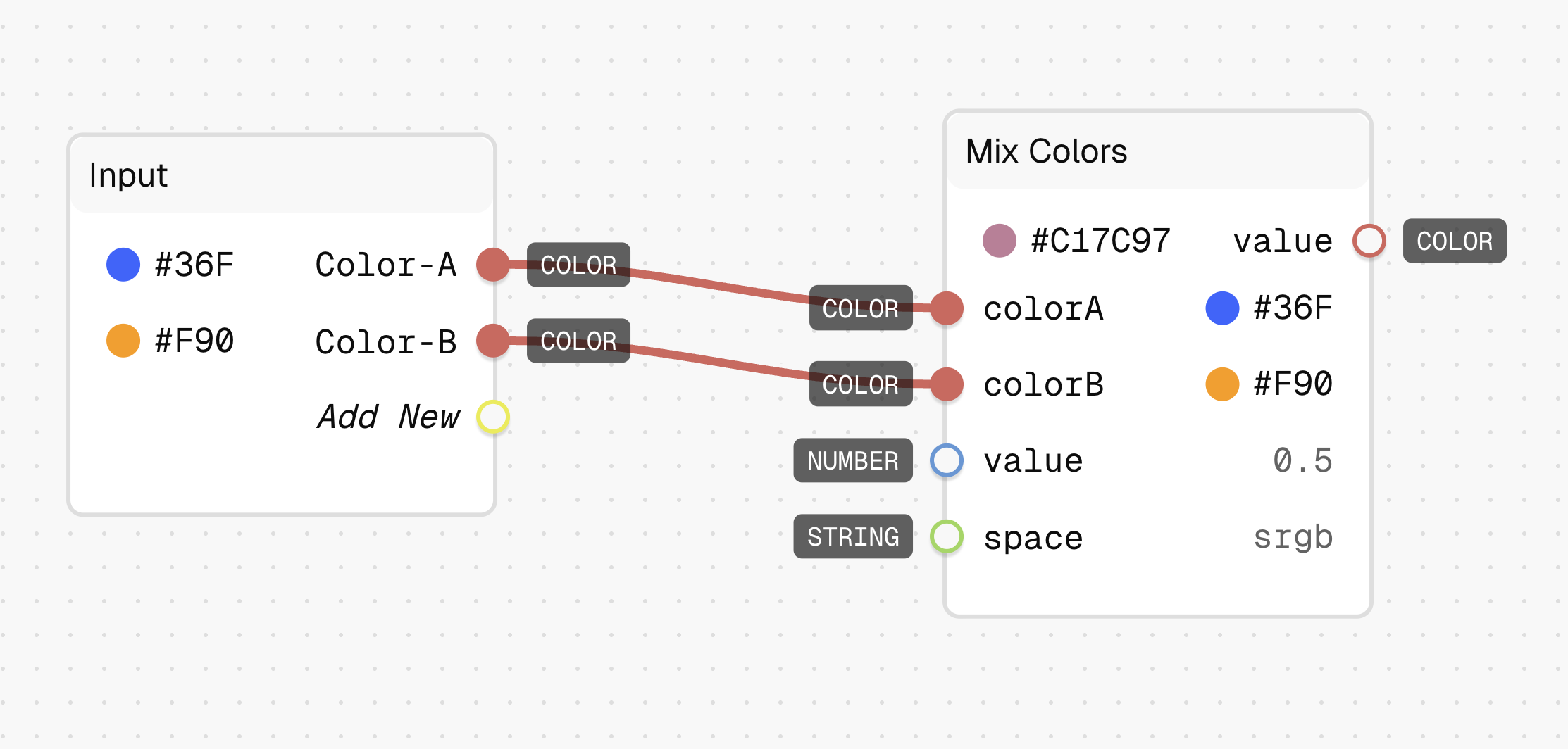
- Drag the Mix Colors node into your graph.
- Connect your first color (like
#3366FF) to the "colorA" input. - Connect your second color (like
#FF9900) to the "colorB" input. - Set a value between 0 and 1 (like
0.5for an equal mix) to the "value" input. - Run the graph—your output will be a blend of the two colors (in this case
#C17C97).
Tips
- Different color spaces produce different mixing results. Try "oklch" for perceptually smooth blends.
- To create a color scale, use multiple Mix nodes with different mixing values.
See Also
- Range: For creating a series of colors between two endpoints.
- Lighten Color: For simple lightness adjustments to a single color.
Use Cases
- Color Harmonies: Mix complementary colors to create harmonious accent colors.
- UI State Variations: Create hover or active states by mixing with white or black.
- Gradient Development: Generate intermediate colors for smooth multi-color gradients.