

Distance
What It Does
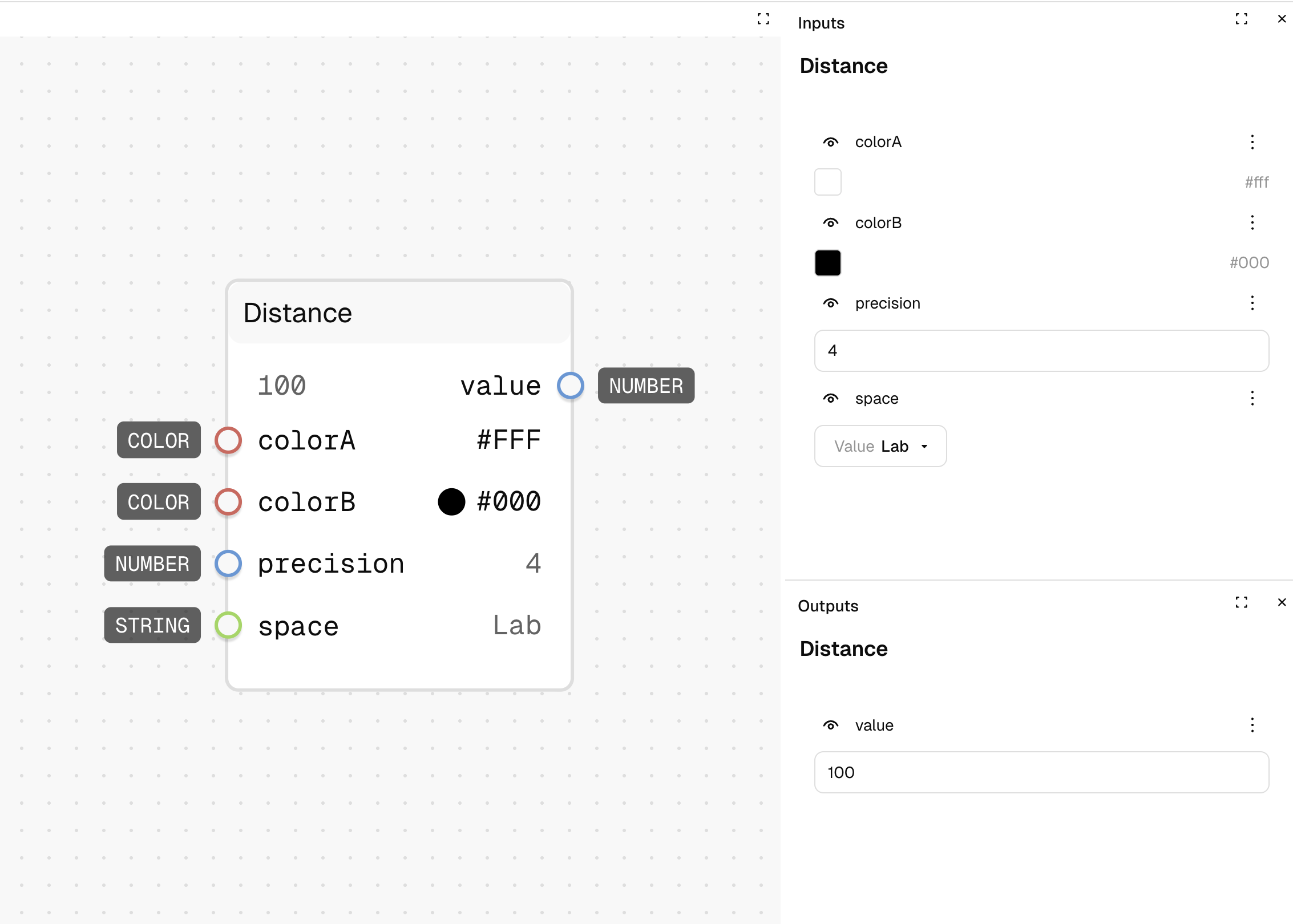
The Distance node measures the geometric distance between two colors in a specified color space. Unlike Delta E, which measures perceptual difference, this node calculates raw mathematical distance between color coordinates. The output is based on the CIEDE2000 color difference formula.
Inputs
| Name | Description | Type | Required |
|---|---|---|---|
| Color A | First color for distance calculation | Color | No |
| Color B | Second color for distance calculation | Color | No |
| Precision | Number of decimal places in the result | Number | No |
| Space | Color space to perform calculation in (Lab, ICtCp, Jzazbz) | String | No |
Outputs
| Name | Description | Type |
|---|---|---|
| Value | The calculated distance between the colors | Number |
How to Use It
- Drag the Distance node into your graph.
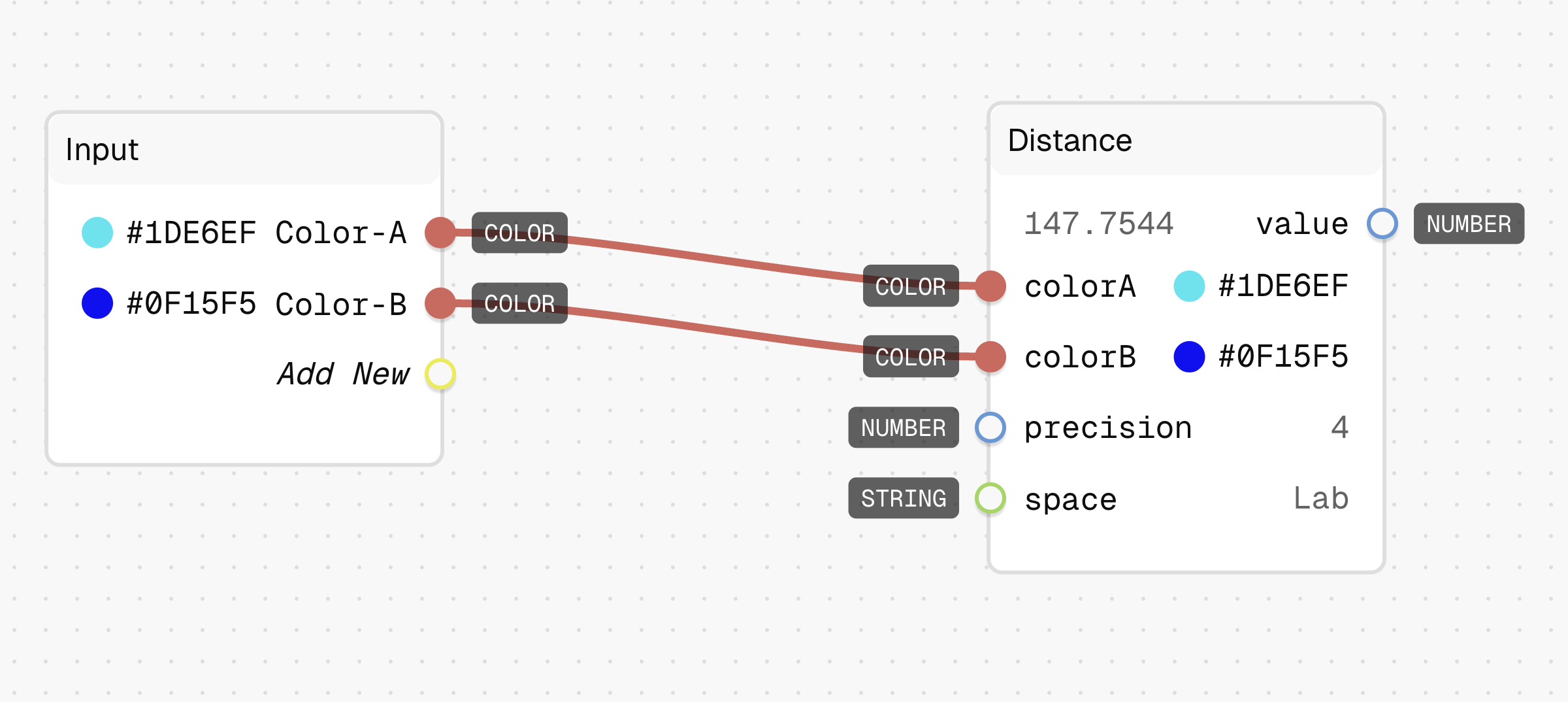
- Connect two colors to "Color A" and "Color B" inputs.
- Select a color space (default is "Lab").
- Set the desired precision for the result (default is 4 decimal places).
- The output value indicates the geometric distance between the colors.
Tips
- Different color spaces produce different results as they represent color differently.
- Lab is generally a good default space for most design applications.
- Higher values indicate greater distance/difference between colors.
See Also
- Delta E: For calculating perceptually accurate color differences.
- Sort Colors By Distance: For sorting colors based on their differences.
- Contrast: For calculating contrast ratio between colors.
Use Cases
- Color Sorting: Organize colors based on their distance from a reference color.
- Color Difference Analysis: Compare color similarity in mathematical terms.
- Color Space Exploration: Understand how colors relate in different color spaces.