

Gradient Stop
What It Does
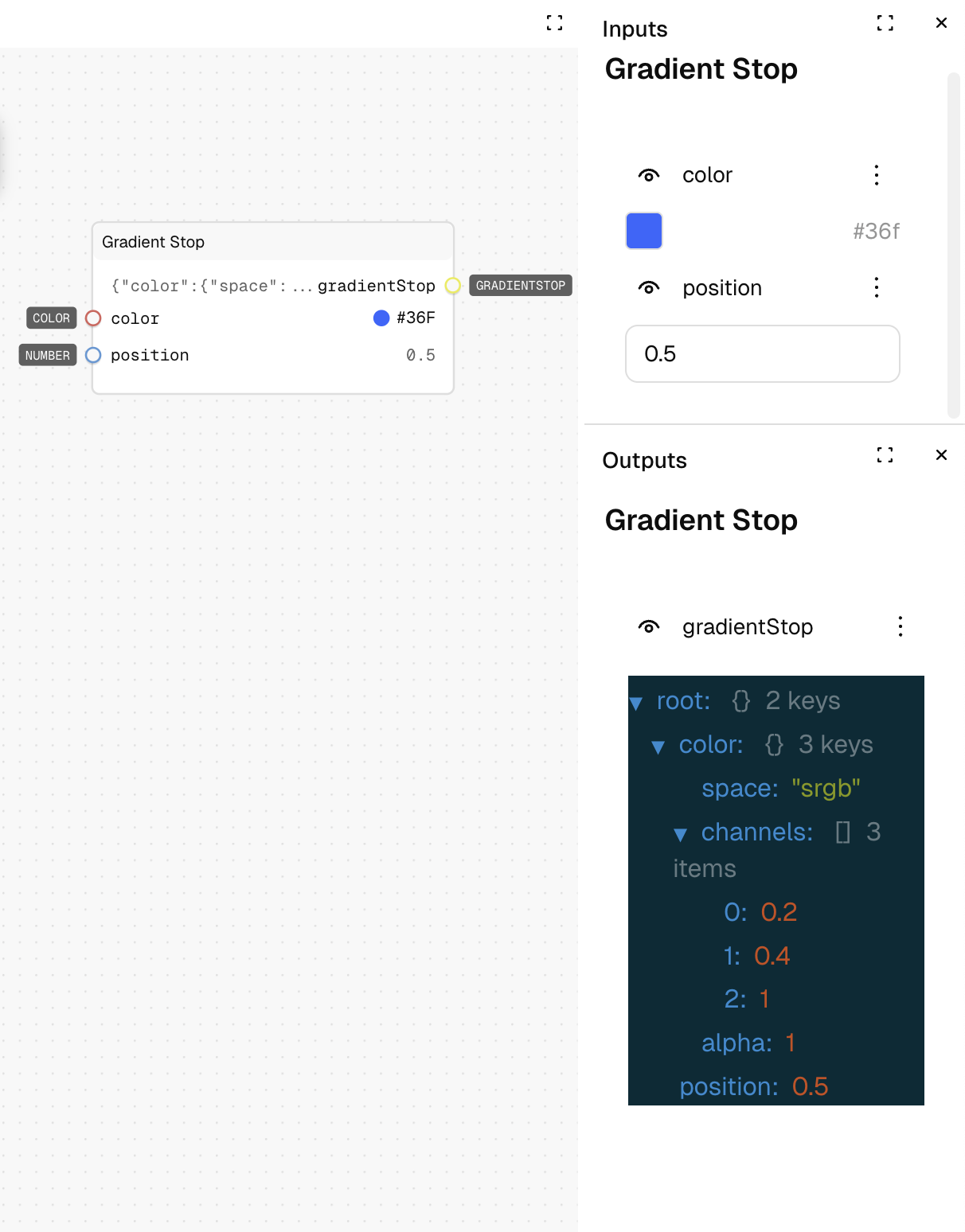
Creates a gradient stop by pairing a color with a position value. Gradient stops are the building blocks of gradients, defining which colors appear at specific points along the gradient line or radius.
Inputs
| Name | Description | Type | Required |
|---|---|---|---|
| color | The color at this position in the gradient | Color | Yes |
| position | The location of this color (typically 0-1) | Number | Yes |
Outputs
| Name | Description | Type |
|---|---|---|
| gradientStop | The combined gradient stop object (color + position) | Gradient Stop |
How to Use It
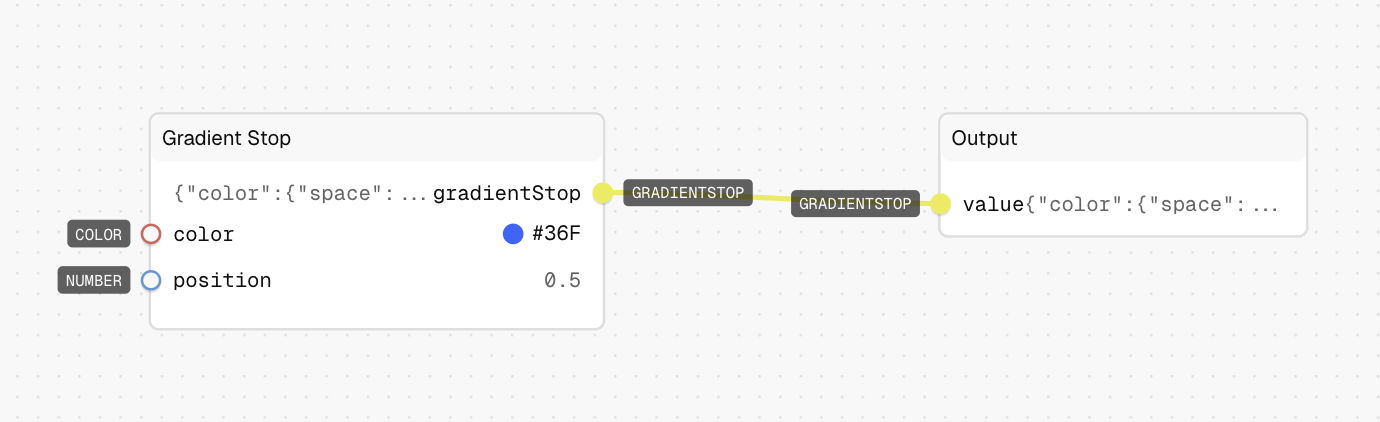
- Drag the Gradient Stop node into your graph.
- Connect a color (like
#3366FF) to the "color" input. - Connect or enter a position value (like
0.5for the middle of the gradient) to the "position" input. - Run the graph—your output will be a gradient stop that can be used in a gradient definition.
Tips
- Position values typically range from 0 (start of gradient) to 1 (end of gradient).
- Create multiple gradient stops and combine them to create a full gradient.
See Also
- Create Gradient: For combining multiple gradient stops into a complete gradient.
- Color Mix: For creating intermediate colors that can be used in gradient stops.
Use Cases
- Custom Gradients: Design multi-color gradients with precise control over color positions.
- Color Transitions: Define exact transition points between colors in a UI element.
- Theming: Create gradient definitions that can adapt to different color schemes.